Wednesday, July 22, 2009
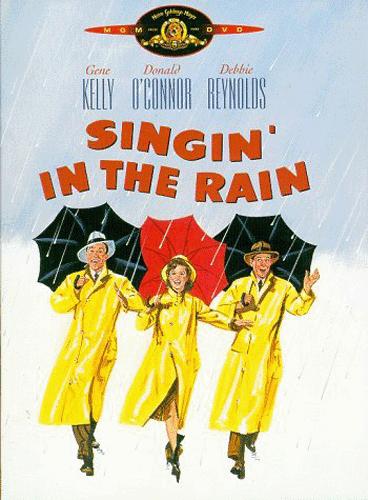
Filmspotter's Top 100 Movies #18:Singing in the Rain

Friday, July 17, 2009
Filmspotter's top 100 movies #66:Some Like It Hot
Some Like It Hot is a movie about two men who, when they become witnesses to a mob massacre, dress up as women to avoid death. This summary is to help all the people who lived under a rock since 1956 and yet are, for some strange reason, reading this. Some Like It Hot was underwhelming. Don't get me wrong it's a good movie, and a lot of elements are fantastic, but great comedies should be hilarious right? My favourite comedy, This is Spinal Tap, is like this. If I turn it on for two minutes, I'll usually be in tears I'm laughing so hard. And Some Like It Hot has one thing that keeps it from being great. While it is humorous, it never seems to hit genius levels. Funny but not brilliant. Not laugh out loud.
But there are elements I appreciate, and there was never a dull moment. While I have a small problem with the shift between the story of how Lemmon and Curtis try to fit in to them running from the mob, Wilder never allows the film to slow down and I appreciate that. The performances are fantastic, with both Lemmon and Monroe performing brilliantly. Tony Curtis, however, was the real stand out, not only because his name didn't stand out next to Lemmon's and Monroe's, but also because he was my favourite performance. And the final line lives up to it's hype.
But the main problem is I didn't laugh that much at Some Like It Hot. I chuckled once or twice, but other then that final line, I was never in stitches. That's just it.
Verdict: Worth a watch, but Some Like It Hot was definitely a disappointment.
Filmspotter's Top 100 movies #63:Rashomon
.jpg)
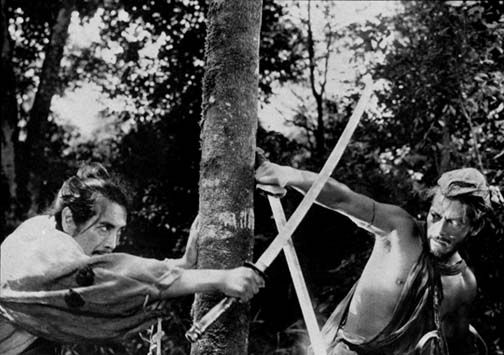
Rashomon is about multiple perspectives. Stating the obvious, right?
But Rashomon is not a murder mystery. Unlike, say, a hollywood production of this story, it does not involve a foil for the audience trying to sieve through the multiple perspectives, and by the end a twist shows us who the killer REALLY is. No, from the opening moments of the film, it's obvious that Kurosawa is presenting us with a whole new dilemma altogether. We meet two characters who had appeared at the trial that day, as another character asks him to recall the story.
Interestingly, the man who arrives and is being told the story is the man who is supposed to be the foil for the audience. Kurosawa then corrupts the last man who is our connection to this story. But I digress.
When we meet these two, they are rambling on about how none if it makes any sense. We see the trial unfold, the stories play out. Kurosawa is, in a sense, creating a real world, one where there are no objectives eyes. One where the audience has no way into the story.
We learn early on what, in a sense, happened. A bandit(Toshiro Mifune) raped a woman and her husband is dead. But how did it happen? Was the woman raped or did she give consent? Did the bandit slaughter the man, or was it suicide? Each story, even the man at the end, is trying to tell the story that puts each person in the best light. Each story is built on personal gain.

Sunday, July 12, 2009
The films of 2009: Public Enemies

After a jail break, we are located in a car escaping from the Indiana(I think it's indiana) state penitentary. Mr Depp has a problem facing him. Sitting next to him is a man who set off the alarm and caused a firefight at the front gate of the prison, resulting in the death of one of the other criminals running away. The Pirates of the Carribean Depp would forgive him, realising that all men deserve a second chance, and he'll probably save them all in the end. This Depp hits him twice in the face and throws him out of the car.
We obviously haven't seen this Depp onscreen before. While he's obviously been in touch with his dark side, those have mostly been in the gothic worlds of Tim Burton. Here he's much more introverted, he's always closed off to the audience. Here, he's not overacting.
This movie is a firestarter. In a summer that brought us Transformers 2 and GI Joe, this is a unique film that would stand out even among the arthouse months of sep/oct/etc. Long shots, close ups, all unconventional.
This was expected. But everyone seems to have reacted copmpletely different from each other on this movie. For every person who claims that the last third ruins the movie, there seems to be another person who believes it redeems the movie. Everybody's got a perspective on Public Enemies.
The main problem with Public Enemies is that it doesn't seem to be anything anybody wants it to be. It's not heat in the depression. Mann does not focus on the cat and mouse chase between Dillinger and Melvin Purvis(Christian Bale), but more the lives of each men at that time. Sometimes Mann uses Long, still shots that feel like they came out of Ran, but then he'll use shaky, digital close ups. The style is at odds with itself.
It's a shame, because the style is fantastic. Mann's choice to shoot on digital allows the movie to put you straight into this world of 1930's Chicago. However, the period doesn't mean a thing to Mann. He doesn't seem to care about the period, what's going around Dillinger and Purvis, but just about them. I think that's smart, as the material covered in the book Public Enemies is too broad for one movie, but this also leaves out a lot of fascinating material to work with, another reason people have reacted less kindly to Public Enemies.
One of the moments sticks out for me. Not the long shootout in the mountain retreat(although that is great) but it comes when Dillinger is caught again, if only for a short while. He has to be extradited to Indiana(I think it's Indiana). Mann then gives us one of the most suprisingly beautiful montages in cinema history, I think. The cinematography is at it's best, the shots are absolutely breathtaking.
Verdict: While nobody's going to leave Public Enemies hating it, it did seem a massive dissapointment. Me? Well, I liked it more then everyone else.
Saturday, July 11, 2009
CD#1 Pink Floyd- Dark Side of The Moon

Pink Floyd's seminal 1973 album, Dark Side of the Moon, may be the perfect opening to my transition year journal. A CD loved by multiple people, it's inclusion on your Ipod will immediately redeem yourself in the minds of anyone who has heard them. Put simply, there are people who love Dark Side to the Moon, and people who haven't heard it.
I am not going to break this pattern in any way. What Dark Side of the Moon alternates between smart pop songs, soulful rants, Sprawling epics, and whatever the hell On The Run is. But even that seems to be undercutting the album, as it's so beautiful that it's hard to put into words exactly what kind of power Pink Floyd exudes upon the listener.
After an 1 minute opening played in front of industrial dialogue and sounds, we start on Breathe. Already Floyd has pulled us into a trance, it's swirling beats creating a beautiful mood. On The Run feels remarkably fresh and inventive even by today's standards. Time deals with humanity's complete dismissal of the short lives given to us, and Money seems to be contradicting itself all the time, talking about the rich and the poor, dealing with society's takeover by money.
The next four songs seem to blend together. Sure the whole album runs together, the endings moving from one track to another and beats bridging gaps, but noone's going to mix up Money and On The Run. However, Us And Them, Any Colour You Like, Brain Damage, and Eclipse seem to form together to create a long song that is just cut into three pieces to please listeners. It's masterfully done, creating a group of songs that's easy on the ears but also creates a mood that sucks you in. Eclipse ends the album on an epic note. More ambitious then the other three songs in it's group, Eclipse talks about all that is lost on the dark side of the moon, what we will lose at the world's end.
Best Song: Great Gig In The Sky-Roger Waters screams to the heavens as the world falls to pieces around him. Pure magic.