Monday, October 19, 2009

70's marathon #6:Easy Rider


"We Blew It." Wyatt(Peter Fonda)

I like to assume the kind of people reading these reviews has heard of, if not all of the movies in this marathon. I usually don't feel the need to go into plot details and the full cast of actors just to inform people who aren't fully schooled in new Hollywood film or how is too lazy to type these titles in on google. I'm a film reviewer and don't feel the need to keep everyone up to speed.

So it would be cliche of me to begin this review of Easy Rider by mentioning the counter-culture revolution of the late 60's. but sometimes a film is so inexorably linked to a subject that there is no way out, that the subject must be mentioned along with the movie. Easy Rider will always be linked to the counter culture revolution due to the fact that it deals with it more bluntly then any other film yet. because it shows how the revolution failed. It shows that no matter how much free will and spirit we may have had, that in the end, we couldn't stop, and so the world made us stop. In a hail of shotgun blasts.

And to be fair, I didn't love Easy Rider when I first saw it. I thought it was an enjoyable but not great movie, a collection of fun encounters with passersby and Jack Nicholson, culminating with three harrowing scenes at the end. But thinking about the movie and putting my thoughts down in words really makes me understand more of what's going on behind the movie. What this movie is is an amalgamation of why the counter culture revolution was not a success.
"A man looked for America, and couldn't find it anywhere" I mean, doesn't that line speak volumes about the movie, about life! Especially back then, America, the ideal America, is such a hard thing to find because everybody has a different idea of what America is. And these two free men want to find America, and they do, multiple times. They just don't find their America. That's what makes Wyatt go at the end "We Blew it." they believed in something that wasn't there, and then they had to pay the consequences.
There are some great scenes. Nicholson is fantastic, and his two monologues(on UFOs and freedom) are great, especially the second one, and there's a great scene in a diner where the three men are stared at by the locals. But then there's that absolutely harrowing drug induced haze near the end, which feels so out of place with the rest of the movie. It could be considered a flaw in the narrative but, fine, I was devastated by it. And that satisfies it's inclusion for me.
Verdict: Easy Rider says a lot about America, values and the rest. And what it's saying is compelling viewing.

Friday, September 25, 2009

70's Film Marathon #5: Rosemary's Baby


Rosemary's Baby feels like an anomaly in this marathon. Sure we have the tracking shots and quick cuts, the destructive personalities of the wife and husband, but it's more like the those airport novels of Dan Brown, and not that it's schlocky, but that it's all about one thing. It's all about the conspiracy. Why are all these neighbours and doctors acting so strangely, why is Rosemary feeling awful, and what, what, is going on with this baby? Why do they want her?

Polanski's film is more reminiscent of the films of Von Trier then any of these counter-culture films that have come before in the marathon. The breakdown of Mia Farrow seems pulled straight out of Antichrist(Although, taking into account time and importance of the two films, it would seem more proper to say Antichrist is more reminiscent of Rosemary's Baby, but I digress)

Coming into Rosemary's Baby I had someone say that they were interested to hear my take on the movie and said "I wasn't really scared by it, more disturbed". But you have to go into Rosemary's Baby thinking that way. This is not a scary movie, but a movie that leaves an impression on you. I couldn't let that final moment out of my head.

Polanski's camera starts off flowing. When we first enter the house, it's moving through the house with elegance, floating through it like a dream scape. We later figure out this is more of a nightmare, but the cinematography never loses that dreamlike landscape. But the cinematography stays anonymous, it's never a factor that completely comes into play.

The acting is remarkable. Mia Farrow is so delicate at the start and she gets torn about by the events but never loses that delicate touch she has, which makes her performance all the more devastating. She feels like the exact opposite to Jeanne Morreau in Jules Et Jim, where that character is all personality, Farrow is all about situation, and how her innocent character is exploited. John Cassavetes is suitably strange as the husband, but it's Ruth Gordan who steals the show as the absolutely terrifying next door neighbour(and even Charles Grodin from Midnight Run has a small appearance!)

Verdict: Rosemary's Baby really worked for me. It's a devastating portrait of the disintegration of a woman and the people who exploit her for their own gains. when put like that, Rosemary's Baby can mean so many things.

Sunday, September 20, 2009

What I've been listening to: Sep.20th


I've decided that having a music review blog is useless, because I'm not a music reviewer. However, I am listening to a lot, and this will hopefully be a weekly post to keep track of it.

Reptilia-The Strokes: The big song at the moment, the one I can't stop listening to. I love Is this It, but Reptilia is better then those songs(except for maybe Trying Your Luck). The Strokes just know how to create awesome guitar riffs that aren't meant to rock hard(Which they do) but are just there to be great music. Reptilia is one of their best songs.

Dots and Dashes-Dealership: I'm always listening to this song. Unfortuantely I can't find the mp3 anywhere(it's availible on Myspace though). But this song is so deceptive. It looks like cheery pop at the start, good cheery pop, but it takes a left turn by the end. And I love left turns. Dealership aren't the best band but I hope their next album has more songs like this.

Papa Won't Leave You Henry-Nick Cave and The Bad Seeds: Probably Cav'es second best song, behind Carry Me, Papa Won't Leave You Henry is so raw and ferocious that you can't turn it off. It's brilliant, beautiful, destructive, and so much more. I'm always in aw of what Nick Cave can do.

Surfer Rosa/Doolittle-Pixies: I downloaded both of these and it's so hard to choose which is better because they are so different in tone and style but are both incredible. Those Pixies are so inventive. However, you know the phrase Sophie's choice? I'm gonna change the phrase to Pixie's choice.

When Doves Cry/I Would Die 4 U-Prince: Totally awesome, though these are the only two songs I've really listened to on Purple Rain. I should listen to more of it.

Knives Out-Radiohead: Radiohead are god, I'm declaring it here. But I haven't been listening to them much recently and so I went back through their albums and was presently surprised by how good they really were. And Knives Out was the song that really went from solid Radiohead to now being one of my favourites. It's like a dark, idiosyncratic version of Seeing Other People by Belle and Sebastion. And I respect that.

Cosmic Dancer-T. Rex: Brilliant.

Wednesday, September 16, 2009

70's Marathon #4: The Graduate

The opening scene of the Graduate scares me to my very core. We see Benjamin Braddock, the ever brilliant Dustin Hoffman, in his room after he has graduated college, obviously avoiding something. He gets pulled by his parents downstairs to meet a large groups of adults looking to wish him congrats on his award.

As a teenager, there is nothing that scares me more then socialites.

Maybe this is the reason that Ben is so attracted to Mrs. Robinson. Compared to the drawl of neighbours and parent's friends, Mrs Robinson is a character straight out of Truffaut's Jules Et Jim. While Truffaut's oblique and oblong camera angles are somewhat an influence on Nichol's style here(but not incredibly), the biggest rip is the destructive Mrs. Robinson very much influenced by Jeanne Moreau's Catherine.

This is not to say that The Graduate feels like a rip off of Jules Et Jim, but the influence is felt. But the colours and style are different. The Graduate's Ben is the real card up the sleeve, a neurotic, strange, yet relatable character. This is not a figurehead for a revolution, nor should it be, but Braddock has a quality to him that sets him apart from the old hero's of Grant and Stewart. He's not heroic. He doesn't know what he's doing. and he's not head strong. He's self lacerating and never sure of himself. The choice he makes will haunt him.

The construction was another part of the film I enjoyed. While I believe Nichol's art direction, his colours aren't great, his unconventional camera angles were great, and I always loved to watch him keep twisting his angles, trying something new. Shots of the reflection of a table showing Mrs. Robinson's entrance to turn up to see the actual image of the duo, the iconic shot of Mrs Robinson putting her tights back on, and the great long POV of Ben in the scuba suit.

And, of course, the soundtrack's pretty good too.

Verdict: What else is there to say about The Graduate? Those socialites still scare me.

Saturday, September 12, 2009

70's Marathon #3:Bonnie and Clyde


"This here's Miss Bonnie Parker. I'm Clyde Barrow...We rob banks." Clyde Barrow(Warren Beatty)

Bonnie and Clyde, Arthur Penn's 1967 gangster classic, is the first American film in my marathon, and I'm having trouble trying to talk about. Up until this point, gangster films involved Jimmy Cagney and Humphrey Bogart scowling with trench coats and Tommy guns. While Tommy guns are present in Bonni and Clyde, the Clyde gang were not criminals. they were ordinary people who committed criminal acts.

CW Moss was a kid, one who was brought into the parent hating, society attacking world inhabited by Bonnie and Clyde. They were the younger generation, the ones who were against governments and institutions. They were rock stars. they played with the banks, the institutions. On the other hand, we have Buck Barrow, played by Gene Hackman, and Blanche, a role for which Estelle Parsons won an Oscar. Buck seems to be torn between the two sides, but Blanche is 1950's suburban housewife, the opponent to the likes Of Bonnie and Clyde.

Bonnie and Clyde is a beautifully shot film. For the first time in Hollywood history, here we had a colour film that wasn't a glorified, brightly light Vertigo-esque world. the gorgeous sepia tones(although My favourite colour is sepia, so I may be biased) create a new landscape. Here is a world that has not been seen before by Hollywood. this is not fantasy, this is reality.

However, I had some problems with Bonnie and Clyde. As an instigator, as a revolution starter, it's perfect. But on reflection, it has some problems with it. It takes a lot of time to get into the world of these characters and, for me at least, to understand the emotional reality. You have to look beyond what could have easily be looked at as a fun romp and watch the characters form the outside. But for the first 45 minutes all it is IS a fun gangster on the run, with comedic moments like when they take a bank which had closed down three weeks earlier. Tensions rise, but never hit a head until what I'm going to call the fantastic "circular grassland shootout scene" not the end scene, the shootout before that. It's a great scene, where the consequences of the gang's actions become apparent.

Two scenes stick out for me. The final scene, cut quickly, is already in the record books and I endorse everything said before and don't have anything else to put into the conversation. the second scene is the one that contains the quote I used above. I love that moment because you can see the tangible delight on Beatty's face when he utters those words. It makes up for any other bad acting he does in the movie, which isn't to say he's bad, both him and Dunaway are fine, but they were different performances then I expected, and will need further examination before I form a proper opinion.

Verdict: As a revolution starter, it's brilliant. As an actual movie, it can leave a bit to be desired.

Friday, September 4, 2009

70's Marathon #2:Jules Et Jim


It's very interesting to try and compare the differences between the two famous french new wave filmmakers, Godard and Truffaut. Both started out their filmmaking careers by burning any form of New Hollywood form for making movies. Then they went in different directions. Godard preceded to do all he could to give the middle finger to the establishment. Now, this could easily turn into a filmmaker who is really only studied by Film historians and critics as one who turned film language on it's head. But, as I talked about when I reviewed Breathless, that was not the case at all. But I'm getting off point. Truffaut burned the rulebook, but instead of consciously trying to screw Hollywood filmmaking, he was creating his own rules and it was always in the service of the story. In a movie like The 400 Blows, Truffaut was not cutting deliberately to hide the camera, but neither was he jumping disarmingly.

This is also the case for Jules Et Jim. Truffaut's camera is not as flashy as Godard's, but is also very stylish, with quick pans and long shots. You get something like the race on the bridge, which goes from shaky tracking shot to shaky close up. The camera feels put in strange places, which feels pre-ominous. But Jules Et Jim, for me, is more about the story. More compelling then 400 Blows or Breathless, Jules Et Jim is about two friends, one who meets a women who conspires to destroy them both.

I don't mean their friendship, I mean literally destroy them. Catherine is a fantastic character, because she is such an enigma. She is constantly shifting between Jules Et Jim, her mind cannot focus on one of them. When we meet her, she is friendly, interesting and exciting, but that changes when she gives birth and her and Jules settle down in a cabin in nowhere. Her true emotions are hidden by this language she employs and her surface emotions. Jeanne Moreau plays it to perfection, and it is amazing to watch her tear apart these two friends, inside and out.

The story is much heavier and much more complex then the other two New Wave movies I have seen. Both Jules Et Jim are intellectuals, and not very different. Jules is a German who is not very good with women, and he becomes infatuated with Cathrine first. Jim is someone with many girlfriends, but most of them are very plain and, while seemingly nice, very ordinary. They are not Catherine. Oskar Werner and Henri Serre are both very good in their roles.

Truffaut's camera is masked more here then in 400 Blows, and much more then Breathless. But a new style of filmmaking is evident here as much, such as the short, sharp trakcing shots around the statues on an island where the two friends are looking for a specific statue. You can see the influence on the films I have seen from the new hollywood period of filmmaking, and it will probably show up in the multiple other films I will see in the marathon.

I am going to be happy to have a change of style, but I did love these New Wave films. and Jules Et Jim is one of the best.

Verdict: Fantastic. The story is deeper then in the other two new wave films I have seen, and is so compelling that you have to see Jules Et Jim.

Friday, August 28, 2009

School's Tomorrow

Greattt...

Friday was the fantastic PowerPoint presentation we got all about what happens in Transition year. I'm hoping, with transition year starting, that I can talk more about day to day occurrences as well as the obligatory film/CD review. So.. What happened on the first (unofficial I guess) day?

Wait, let me get my bible.

The transition year bible. I know.

The presentation was most of the stuff in the most wimpy looking bible you have ever seen so I'm just gonna get through this.

I don't know whether the schedule is good or not because I'm not sure if the classes are good or not, so we will see.

Another schedule on page 2.

It makes me wonder why anyone is reading this because this is obviously boring the hell out of anyone who is.

Scrap this.

I'm worried about tomorrow. After Greece(Did I mention I went to Greece during the Holidays? It wasn't exciting, just a lot of sun and swimming) My body had become spiritually pure(If you believe in that stuff) but, I'm just wondering if that'll make living with these people an absolute slog. Then there's the fact that none of these options appeal to me. And I'm hoping I can get out. Multiple thoughts flowing through the head.

Oh, and also, I am not in Film Studies. This is very strange. And not very smart.

Meh.

Sunday, August 2, 2009

70's Marathon #1:Breathless


Godard's seminal 1960 film
Breathless(A Bout De Souffle),
Was the crowning acheivement of the nouvelle vague.
Yes,
1959's the 400 Blows, is one of my favourite films of all time,
and Jules Et Jim, another
by Truffaut, are beloved as much
as Breathless,
but why Breathless is the greatest acheivement of the Nouvelle Vague
can be condensed down into two words:
Jump Cuts
Truffaut
was a very commercial director.
Not to say that his films were hollywood,
but of all the nouvelle vague directors, he was the least fascinated
by breaking the rules of cinema.
It's obvious by the first 5 minute sequence, where Jean-Paul
Belmondo
is driving a car down a highway, and then shoots a cop,
is not only there to
set up the story but also
to
showcse this new style of filmamking.
Breathless was a delight to watch, which
seems strange for
me to
say
considering the characters and storyline.
Godard's previous film I had seen,
Band a Part,
while techinically brilliant, left me
very cold inside,
very disaffected.

However, from the opening moments
of Breathless, i was completely taken with Godard's editing and camera.
I was felt calm while
watching this
movie
even if the content was disturbing or emotional(not that
it is).
The last time I
felt
this way
was when I saw The 400 Blows.

But another thing that
suprised me
about Breathless is that my favourite moments
were tracking shots
There are some fantastic tracking shots which seems so at odds with what
Godard's editing philosophy.
One of my new favourite shots
of all time
is when Jean Seberg is with her boss and they both walk
down the stairs
You expect Godard to cut, but instead
his camera fluidly turns
to reveal Jean Paul Belmondo sitting at another table. We then follow
Belmondo
as he walks around the back of the store and then follows Seberg. It's breathtaking to watch this shot in motion.
Belmondo is great,
he's very charasmatic and likeable
in what could be a very unsympathetic role.
Seberg is not
as
great, but she is
still very good.
I don't have
much
else to say.
Oh, also, fantastic final tracking shot.
Verdict: Absolutely brilliant. Don't be put off thinking this is high art, it's also emmensely enjoyable(while being high art). The question that's gonna keep me up at night, is it better then 400 Blows?

Wednesday, July 22, 2009

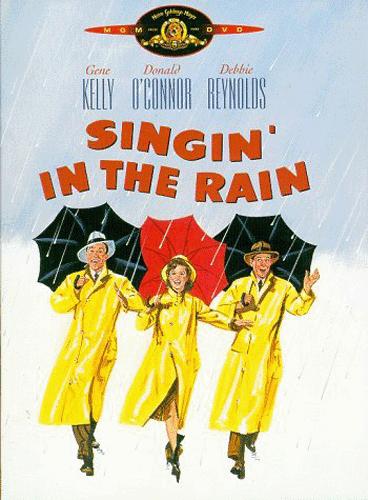
Filmspotter's Top 100 Movies #18:Singing in the Rain


I am not a musicals guy. After deeming both Chicago and Mamma Mia! failures, friends(mostly female) jumped on me, claiming that it's not about story, it's about songs and stuff. Story doesn't matter, as long as the songs work(one problem, they didn't) but of course, while wary of any musicals I was going to see, I felt that before I declare myself a hater of the dancing and singing genre, I should at least one classic of the genre. This then brought me to watch Singin' in the Rain.
I loved it. I mean, my problem with the dreaded duo of Chicago and Mamma Mia is not that they had plots that were not exactly subtle, but that the narrative made no sense. They were messes. Singing in the Rain is not exactly the godfather, but it's plot moves along at a fine pace and allows the numbers to come in. and they are spectacular. Watching Gene Kelly move is just mesmerizing.
But the story is actually very good. It charts the arrival of sound in movies, which makes two huge silent movie stars have trouble dealing with the fact that their voices are not exactly film worthy. While Gene Kelly is not a huge problem, the real problem is Lina Lamont(Jean Hagen), his co-star in almost very movie. Not only does she believe it when the tabloids claim they are in a relationship, but she also has one of the most annoying voices ever known to man. She is despicable, which means that Hagen did her job right.
The story engages the audience, and though the screenplay is nothing groundbreaking, it works. Not to mention that this is actually a very funny movie, even by modern standards("Cosmo, call me a cab!!" "Ok, you're a cab"). All the actors play their non-foot flinging parts well, especially Donald O'Connor, who is a delight. He's fantastic.
Verdict: Gotta Dance!!!

Friday, July 17, 2009

Filmspotter's top 100 movies #66:Some Like It Hot

Some Like It Hot is a movie about two men who, when they become witnesses to a mob massacre, dress up as women to avoid death. This summary is to help all the people who lived under a rock since 1956 and yet are, for some strange reason, reading this.

Some Like It Hot was underwhelming. Don't get me wrong it's a good movie, and a lot of elements are fantastic, but great comedies should be hilarious right? My favourite comedy, This is Spinal Tap, is like this. If I turn it on for two minutes, I'll usually be in tears I'm laughing so hard. And Some Like It Hot has one thing that keeps it from being great. While it is humorous, it never seems to hit genius levels. Funny but not brilliant. Not laugh out loud.

But there are elements I appreciate, and there was never a dull moment. While I have a small problem with the shift between the story of how Lemmon and Curtis try to fit in to them running from the mob, Wilder never allows the film to slow down and I appreciate that. The performances are fantastic, with both Lemmon and Monroe performing brilliantly. Tony Curtis, however, was the real stand out, not only because his name didn't stand out next to Lemmon's and Monroe's, but also because he was my favourite performance. And the final line lives up to it's hype.

But the main problem is I didn't laugh that much at Some Like It Hot. I chuckled once or twice, but other then that final line, I was never in stitches. That's just it.

Verdict: Worth a watch, but Some Like It Hot was definitely a disappointment.

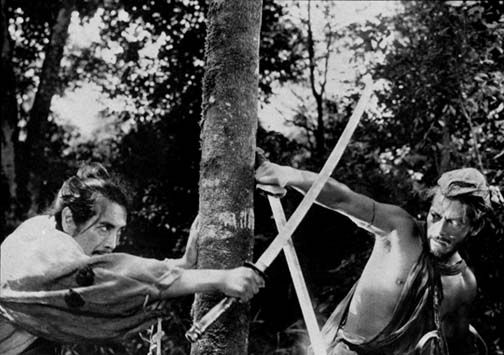
Filmspotter's Top 100 movies #63:Rashomon


Rashomon is about multiple perspectives. Stating the obvious, right?

But Rashomon is not a murder mystery. Unlike, say, a hollywood production of this story, it does not involve a foil for the audience trying to sieve through the multiple perspectives, and by the end a twist shows us who the killer REALLY is. No, from the opening moments of the film, it's obvious that Kurosawa is presenting us with a whole new dilemma altogether. We meet two characters who had appeared at the trial that day, as another character asks him to recall the story.

Interestingly, the man who arrives and is being told the story is the man who is supposed to be the foil for the audience. Kurosawa then corrupts the last man who is our connection to this story. But I digress.

When we meet these two, they are rambling on about how none if it makes any sense. We see the trial unfold, the stories play out. Kurosawa is, in a sense, creating a real world, one where there are no objectives eyes. One where the audience has no way into the story.

We learn early on what, in a sense, happened. A bandit(Toshiro Mifune) raped a woman and her husband is dead. But how did it happen? Was the woman raped or did she give consent? Did the bandit slaughter the man, or was it suicide? Each story, even the man at the end, is trying to tell the story that puts each person in the best light. Each story is built on personal gain.


What really surprised me about Rashomon is how beautiful the construction was. While Ran may still be Kurosawa's best looking film, Rashomon does give it a run for it's money. But they are also very different, style wise. Ran uses a zen like camera, without any camera movements and not a lot of obscure angles.

From the moment we enter the woods, Rashomon is very different. Using short tracking shots and the nature of the forest, Rashomon looks amazing. Kurosawa allows his camera to move around a lot more, and so creates a fluid feel to the film. It also does not let us get a grip on the story.

The acting is not as good as it could be. Mifune is a bit too big, too loud. Machiko Kyo(the woman) is also very big, but she is trying to play the role of the unfortuante damsel in distress, so that's ok. The rest of the cast is great, with no stand outs.

Verdict: The contradictory stories will confuse most of the Transformers loving public, but Kurosawa's look at these contradictions and how the world will forsake the truth to make itself look better is one of the greatest movies ever made. No hyperbole.

Sunday, July 12, 2009

The films of 2009: Public Enemies


After a jail break, we are located in a car escaping from the Indiana(I think it's indiana) state penitentary. Mr Depp has a problem facing him. Sitting next to him is a man who set off the alarm and caused a firefight at the front gate of the prison, resulting in the death of one of the other criminals running away. The Pirates of the Carribean Depp would forgive him, realising that all men deserve a second chance, and he'll probably save them all in the end. This Depp hits him twice in the face and throws him out of the car.

We obviously haven't seen this Depp onscreen before. While he's obviously been in touch with his dark side, those have mostly been in the gothic worlds of Tim Burton. Here he's much more introverted, he's always closed off to the audience. Here, he's not overacting.

This movie is a firestarter. In a summer that brought us Transformers 2 and GI Joe, this is a unique film that would stand out even among the arthouse months of sep/oct/etc. Long shots, close ups, all unconventional.

This was expected. But everyone seems to have reacted copmpletely different from each other on this movie. For every person who claims that the last third ruins the movie, there seems to be another person who believes it redeems the movie. Everybody's got a perspective on Public Enemies.

The main problem with Public Enemies is that it doesn't seem to be anything anybody wants it to be. It's not heat in the depression. Mann does not focus on the cat and mouse chase between Dillinger and Melvin Purvis(Christian Bale), but more the lives of each men at that time. Sometimes Mann uses Long, still shots that feel like they came out of Ran, but then he'll use shaky, digital close ups. The style is at odds with itself.

It's a shame, because the style is fantastic. Mann's choice to shoot on digital allows the movie to put you straight into this world of 1930's Chicago. However, the period doesn't mean a thing to Mann. He doesn't seem to care about the period, what's going around Dillinger and Purvis, but just about them. I think that's smart, as the material covered in the book Public Enemies is too broad for one movie, but this also leaves out a lot of fascinating material to work with, another reason people have reacted less kindly to Public Enemies.

One of the moments sticks out for me. Not the long shootout in the mountain retreat(although that is great) but it comes when Dillinger is caught again, if only for a short while. He has to be extradited to Indiana(I think it's Indiana). Mann then gives us one of the most suprisingly beautiful montages in cinema history, I think. The cinematography is at it's best, the shots are absolutely breathtaking.

Verdict: While nobody's going to leave Public Enemies hating it, it did seem a massive dissapointment. Me? Well, I liked it more then everyone else.

Saturday, July 11, 2009

CD#1 Pink Floyd- Dark Side of The Moon


Pink Floyd's seminal 1973 album, Dark Side of the Moon, may be the perfect opening to my transition year journal. A CD loved by multiple people, it's inclusion on your Ipod will immediately redeem yourself in the minds of anyone who has heard them. Put simply, there are people who love Dark Side to the Moon, and people who haven't heard it.

I am not going to break this pattern in any way. What Dark Side of the Moon alternates between smart pop songs, soulful rants, Sprawling epics, and whatever the hell On The Run is. But even that seems to be undercutting the album, as it's so beautiful that it's hard to put into words exactly what kind of power Pink Floyd exudes upon the listener.

After an 1 minute opening played in front of industrial dialogue and sounds, we start on Breathe. Already Floyd has pulled us into a trance, it's swirling beats creating a beautiful mood. On The Run feels remarkably fresh and inventive even by today's standards. Time deals with humanity's complete dismissal of the short lives given to us, and Money seems to be contradicting itself all the time, talking about the rich and the poor, dealing with society's takeover by money.

The next four songs seem to blend together. Sure the whole album runs together, the endings moving from one track to another and beats bridging gaps, but noone's going to mix up Money and On The Run. However, Us And Them, Any Colour You Like, Brain Damage, and Eclipse seem to form together to create a long song that is just cut into three pieces to please listeners. It's masterfully done, creating a group of songs that's easy on the ears but also creates a mood that sucks you in. Eclipse ends the album on an epic note. More ambitious then the other three songs in it's group, Eclipse talks about all that is lost on the dark side of the moon, what we will lose at the world's end.

Best Song: Great Gig In The Sky-Roger Waters screams to the heavens as the world falls to pieces around him. Pure magic.

Saturday, June 20, 2009

Top 20 movies of all time

20.The Third Man(Carol Reed,1949)

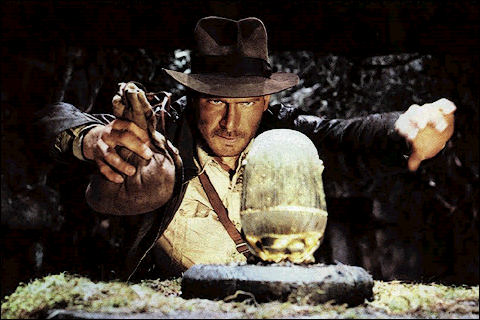
19.Raiders of the Lost Ark(Steven Spielberg,1981)


18.Goodfellas(Martin Scorsese,1990)


17.Pulp Fiction(Quentin Tarantino,1994)


16.Children of Men(Alfonso Cuaron,2006)


15.Leon(Luc Besson,1995)


14.2001:A Space Odyssey(Stanley Kubrick,1969)
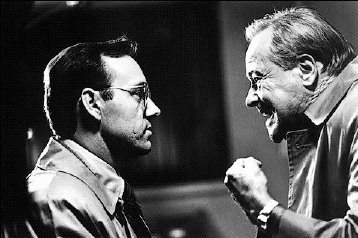

13.Glengarry Glen Ross(James Foley,1992)


12.Brick(Rian Johnson,2006)


11.Ran(Akira Kurosawa,1985)


10.Blade Runner(Ridley Scott,1982)


9.Being John Malkovich(Spike Jonze,1999)


8.Miller's Crossing(Joel & Ethan Coen,1990)


7.The 400 Blows(Francois Truffaut,1959)

6.Serenity(Joss Whedon,2005)


5.The Godfather(Francis Ford Coppola,1972)
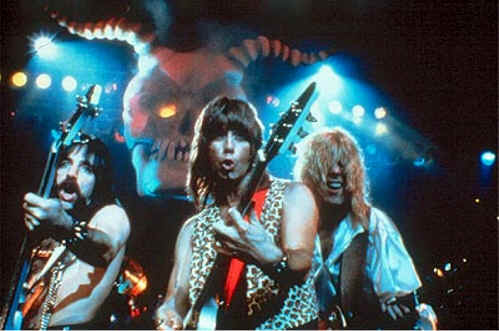
4.This Is Spinal Tap(Rob Reiner,1984)


3.Princess Mononoke(Hayao Miyazaki,1997)


2.Once Upon A Time in the West(Sergio Leone, 1968)

1.Magnolia(Paul Thomas Anderson, 1999)

Tuesday, June 16, 2009

Top 10 albums of all time

My idea was to make my top 10 list of albums and movies before I set out upon this journey to see how much it's changed at the end.

10.Simon and Garfunkel-Parsey, Sage, Rosemary and Thyme

9.Arcade Fire-Neon Bible


8.Nick Cave and the Bad Seeds-Murder Ballads


7.The Good, The Bad, And The Queen-The Good, The Bad, And The Queen


6.Nirvana-Nevermind

5.Badly Drawn Boy-The Hour Of Bewilderbeast

4.Belle and Sebastion-If You're Feeling Sinister


3.Sonic youth-Daydream nation


2.Portishead-Dummy

1.Radiohead-Kid A

Monday, June 15, 2009

Goals!

I'll update this if I come up with more but we'll start with this.

Media:
-To have read 30 novels by the end of the year
-To have read 5 plays by the end of the year
-To have listened to 60 albums by the end of the year
-To have finished all the films in the filmspotter's top 100 films list (http://www.filmspotting.net/boards/index.php?topic=4444.0) and to have finished my 70's movie marathon(I'll put down what movies I have to watch at the end of this article)

Travel:
-To go to Nepal
-To visit friends in San Francisco and London
-To go to a film festival, most likely Venice, Toronto, or Sundance.

Personal:
-To type faster.
-To improve my guitar playing skills.
-To run more.

I'll keep updating this post.

Filmspotter's top 100 movies I haven't seen

100. Network
96. High Fidelity
95. The Silence of the Lambs
93. Nights of Cabiria
92. The Searchers
91. Duck Soup
90. Stalker
89. North by Northwest
88. Crimes & Misdemeanours
87. Paris, Texas
80. Tokyo Story
79. Brazil
78. The Science of Sleep
77. The Passion of Joan of Arc
76. L.A. Confidential
73. The Birds
72. Eraserhead
71. Raging Bull
70. Y Tu Mama Tambien
69. Trainspotting
68. Cabaret
67. The Gradute
66. Some Like It Hot
65. Lawrence of Arabia
63. Rashomon
62. Three Colours: Blue
58. Before Sunrise
53. All The President's Men
51. Notorious
49. Amelie
48. City Lights
47. Before Sunset
45. Breathless
43. M
40. Night of the Hunter
38. One Flew Over The Cuckoo's Nest
37. The Bicycle Thieves
36. City of God
34. Manhattan
29. All About Eve
28. It's A Wonderful Life
26. Sunrise: A Song of Two Humans
23. 8 1/2
22. Touch of Evil
20. A Clockwork Orange
19. Psycho
18. Singin' in the Rain
16. Vertigo
14. Lost in Translation
13. Rear Window
11. The Godfather Part II
7. Annie Hall
2. Seven Samurai

70's films marathon
Breathless(Jean-Luc Godard,1960)
Jules et Jim(Francois Truffaut,1962)

Bonnie and Clyde(Arthur Penn,1967)
The Graduate(Mike Nichols,1967)
Rosemary's Baby(Roman Polanski,1968)
Easy Rider(Dennis Hopper,1969)
Midnight Cowboy(John Schlesinger,1969)
Five Easy Pieces(Bob Rafelson,1970)
Mccabe and Mrs Miller(Robert Altman,1971)
Harold and Maude(Hal Ashby,1971)
The Last Picture Show(Peter Bogdanovich,1971)
The French Connection(William Friedkin,1971)
A Clockwork Orange(Stanley Kubrick,1971)
Straw Dogs(Sam Peckinpah,1971)
Cabaret(Bob Fosse,1972)
Deliverance(John Boorman,1972)
The Last Detail(Hal Ashby,1973)
Mean Streets(Martin Scorsese,1973)
The Exorcist(William Friedkin,1973)
American Graffiti(George Lucas,1973)
Badlands(Terrence Malick,1973)
The Long Goodbye(Robert Altman,1973)
The Godfather Part 2(Francis Ford Coppola,1974)
The Converation(Francis Ford Coppola,1974)
A Woman Under the Influence(John Cassavetes,1974)
Nashville(Robert Altman,1975)
One Flew Over the Cuckoo's Nest(Milos Forman,1975)
Jaws(Steven Spielberg,1975)
Network(Sidney Lumet,1976)
All the President's Men(Alan J. Pakula,1976)
Taxi Driver(Martin Scorsese,1976)
Close Encounters of the Third Kind(Steven Spielberg,1977)
Annie Hall(Woody Allen,1977)
The Deer Hunter(Michael Cimino,1978)
Days of Heaven(Terrence Malick,1978)
All That Jazz(Bob Fosse,1979)
Alien(Ridley Scott,1979)
Apocalypse Now(Francis Ford Coppola,1979)
Being There(Hal Ashby,1979)
Raging Bull(Martin Scorsese,1980)
Heaven's Gate(Michael Cimino,1980)
Reds(Warren Beatty,1981)

And it begins...

The Idea is that in Ireland we have a year called transition year. It's basically an off year, where we travel and learn what we want, in a sense. This is my log of what will be happeneing over the next year. Any reviews of Books/Cds/Films, journals of trips, and random posts should come up.