.jpg)
Rashomon is about multiple perspectives. Stating the obvious, right?
But Rashomon is not a murder mystery. Unlike, say, a hollywood production of this story, it does not involve a foil for the audience trying to sieve through the multiple perspectives, and by the end a twist shows us who the killer REALLY is. No, from the opening moments of the film, it's obvious that Kurosawa is presenting us with a whole new dilemma altogether. We meet two characters who had appeared at the trial that day, as another character asks him to recall the story.
Interestingly, the man who arrives and is being told the story is the man who is supposed to be the foil for the audience. Kurosawa then corrupts the last man who is our connection to this story. But I digress.
When we meet these two, they are rambling on about how none if it makes any sense. We see the trial unfold, the stories play out. Kurosawa is, in a sense, creating a real world, one where there are no objectives eyes. One where the audience has no way into the story.
We learn early on what, in a sense, happened. A bandit(Toshiro Mifune) raped a woman and her husband is dead. But how did it happen? Was the woman raped or did she give consent? Did the bandit slaughter the man, or was it suicide? Each story, even the man at the end, is trying to tell the story that puts each person in the best light. Each story is built on personal gain.
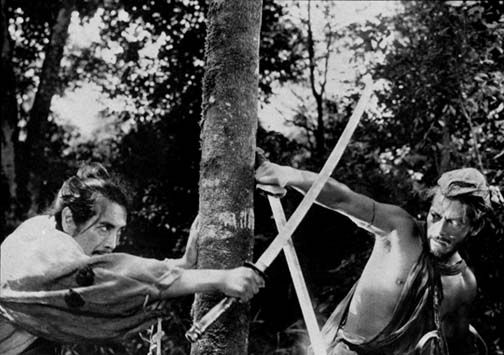
What really surprised me about Rashomon is how beautiful the construction was. While Ran may still be Kurosawa's best looking film, Rashomon does give it a run for it's money. But they are also very different, style wise. Ran uses a zen like camera, without any camera movements and not a lot of obscure angles.
From the moment we enter the woods, Rashomon is very different. Using short tracking shots and the nature of the forest, Rashomon looks amazing. Kurosawa allows his camera to move around a lot more, and so creates a fluid feel to the film. It also does not let us get a grip on the story.
The acting is not as good as it could be. Mifune is a bit too big, too loud. Machiko Kyo(the woman) is also very big, but she is trying to play the role of the unfortuante damsel in distress, so that's ok. The rest of the cast is great, with no stand outs.
Verdict: The contradictory stories will confuse most of the Transformers loving public, but Kurosawa's look at these contradictions and how the world will forsake the truth to make itself look better is one of the greatest movies ever made. No hyperbole.

No comments:
Post a Comment